 Imagen: Revista Realia / Pinterest
The Confessional
that the Devil Moved
Narrated by Professor Manuel Lozoya Cigarroa
The centuries-old cathedral of the city of Durango, with more than four hundred years of existence, has watched unmoved the passing of many generations who have left in its quarried stones the memory of so many events that, transformed into tales and legends, reach us with the timeworn flavor of bygone days, enriching the folklore of this Durango of ours that we all love with passion.
It was the first half of the 18th century, around the year 1738, when the noble and quiet colonial city of Durango, capital of the province of New Vizcaya, was stirred by the news that within the sacred precinct of the Holy Cathedral Church an unprecedented, terrifying, and infernal event had occurred: Juan Pérez de Toledo y Mendoza, in his repentance and eagerness to annul the bargain he had made with the devil, had been found dead inside the very cathedral.
The aforementioned Juan Pérez de Toledo was a man dominated by vice and ambition, born into wealth, who squandered an immense fortune given over to wine, gambling, women, and every vice a human being could carry. Justice pursued him, poverty and vice continued to dominate him, and in a supreme fit of desperation and anguish, seeking a magical solution to his problems, he resorted to asking the devil for aid and help.
In a place distant from the city, out to the east, where the roads crossed, and when the great bell of the cathedral tolled midnight, that man, alone in the darkness, called upon Satan three times. The supreme lord of darkness arrived wrapped in a whirlwind of wind and dust, dressed entirely in black in the fashion of the era, with a cadaverous face in which gleamed a pair of red eyes that gave off fire. After a brief exchange of words, Juan was invested with supernatural powers to obtain money, wine, and women in abundance, merely by wishing for them in his thoughts.
The man continued his disorderly life, while time followed its course in the inevitable succession of days and nights, aging the character of our tale. Until it brought him to utter old age, when he could no longer even manage himself, let alone his vices and dissolute life.
When time ripens the existence of human beings, just as it ripens the fruit on the plant, reflection comes, repentance for mistaken deeds, and at last, the self finds itself. In that supreme instant of repentance and personal shame, the character of this legend felt the need to break the bargain he had made with the devil and sought to outwit the pact.
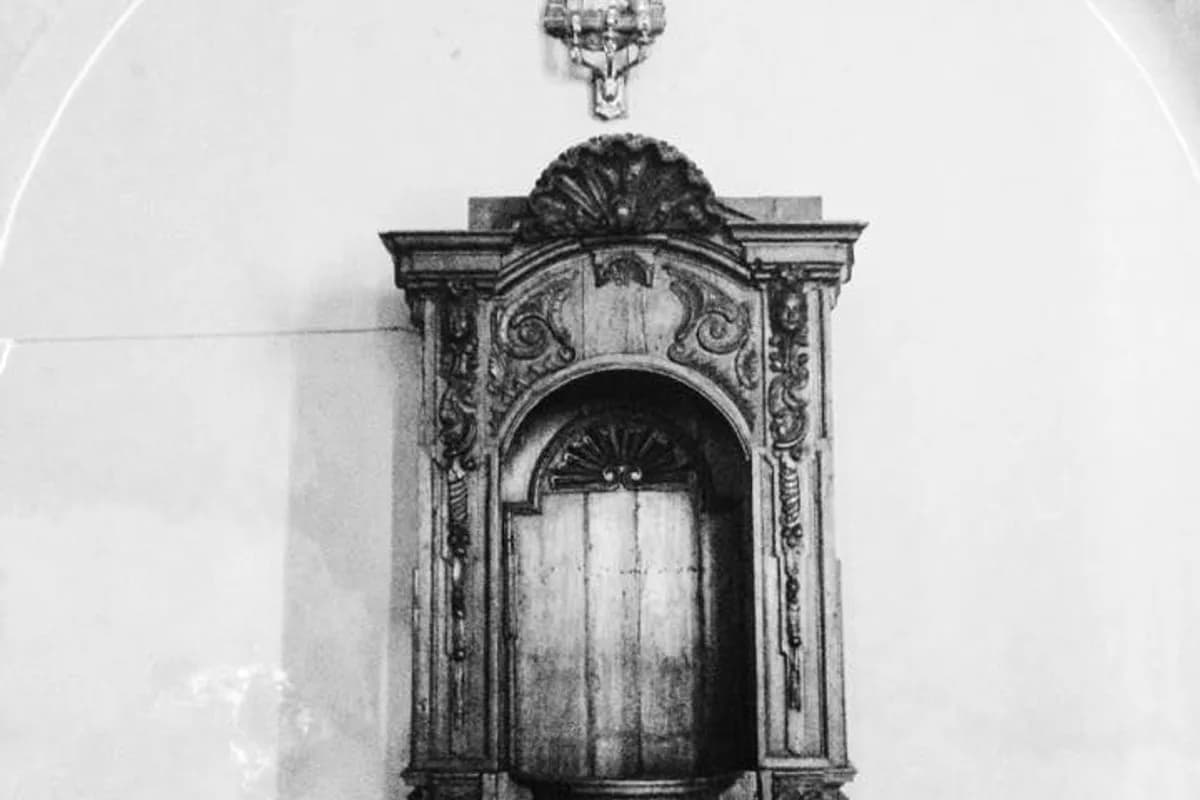
He entered the cathedral, approached a priest asking for confession, and when everything was ready to administer the sacrament, kneeling before the confessor, suddenly the heavy confessional, with the clergyman still seated inside it, was violently lifted, turning its door toward the wall and leaving the man who sought to confess on the far side. He fell dead instantly, while astonishingly the confessor, trapped inside the confessional, began to cry out, begging God for forgiveness and mercy.
Shortly after, the sacristan and other authorities of the temple rescued the priest and lifted the dead man, who appeared to have been burned as if struck by lightning and gave off an unpleasant smell of sulfur.
The news spread through the city like wildfire, and the confessional, loathed by all, was condemned to oblivion, remaining for centuries in a hallway of the sacristy. It is a beautiful and heavy piece of wooden furniture, exquisitely carved precisely in the 18th century, and today stands restored, placed in the right nave of the cathedral, near the sacristy of the beautiful and majestic Cathedral of Durango.
Legend collected from the oral tradition of Durango.
Narrated by Professor Manuel Lozoya Cigarroa.