Cathedral of Durango
Architecture
Monumentality and technical adaptation across centuries: a building that unites New Spanish baroque and neoclassical purity under a single stone roof.
Three Naves,
Centuries of Art
The architecture of the Cathedral of Durango is defined by its monumentality and its capacity for technical adaptation across centuries of construction. The building rests on a rectangular plan, with imposing dimensions of 119 varas long by 68 wide. Its three-nave structure, supported by 24 pillars and covered by 18 vaults, represents one of the most significant engineering achievements in the region.
The transition from the initial ribbed vaults to raising the side naves to equal the central one allowed for superior illumination through its windows and skylights. One of the most significant architectural milestones was the replacement of the old crossing tower with an octagonal drum dome, a change that not only improved the exterior aesthetics but also provided a vertical axis of light over the transept.
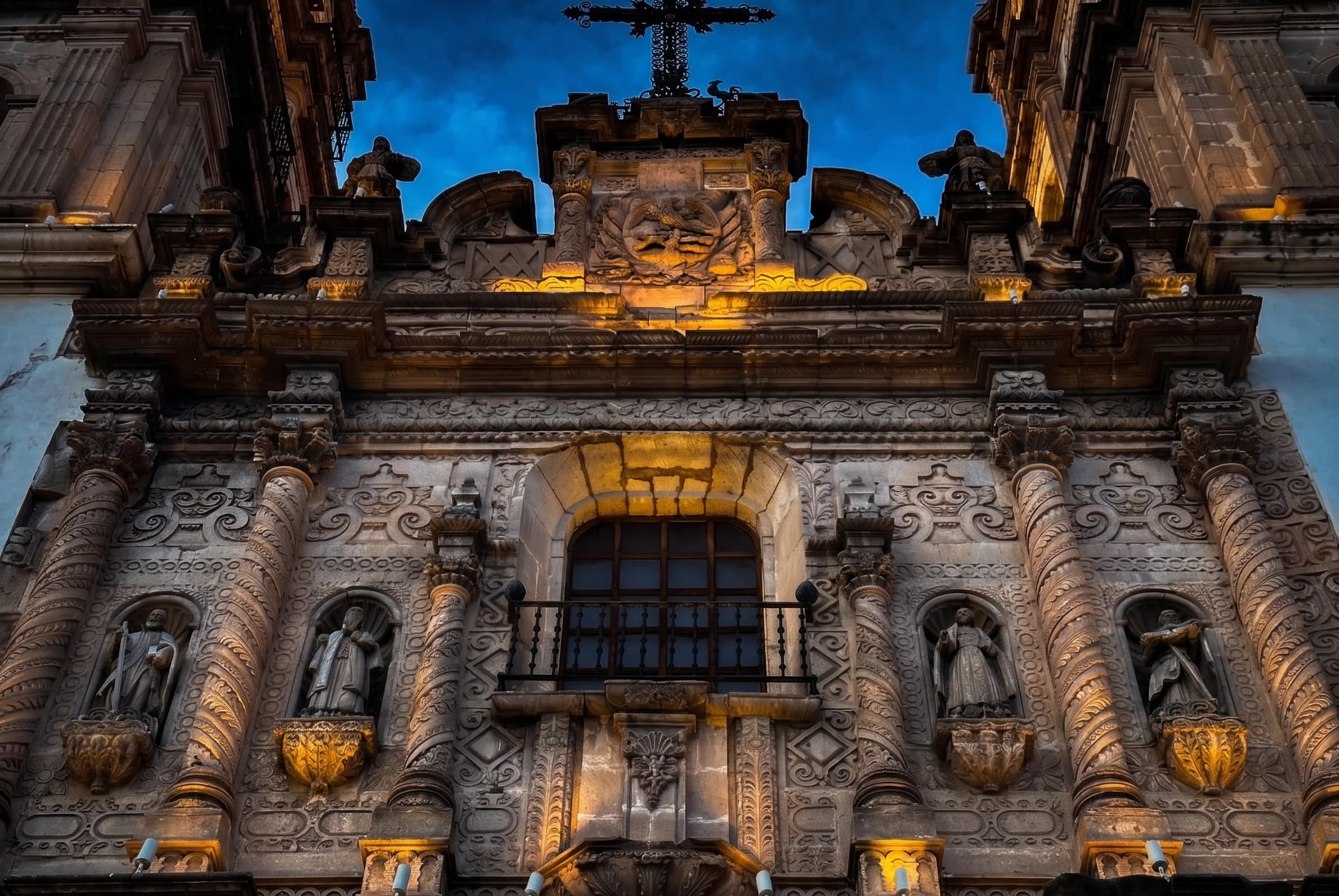
The portals, classified as early, full, and late baroque, display a coexistence of styles: from the classicist ground level of the main portal to the Solomonic columns on the upper tiers, characteristic of the influence of the master carvers from Guadalajara such as Simón de los Santos and José de la Cruz, through to Pedro de Huertas and Miguel de Ontiveros.
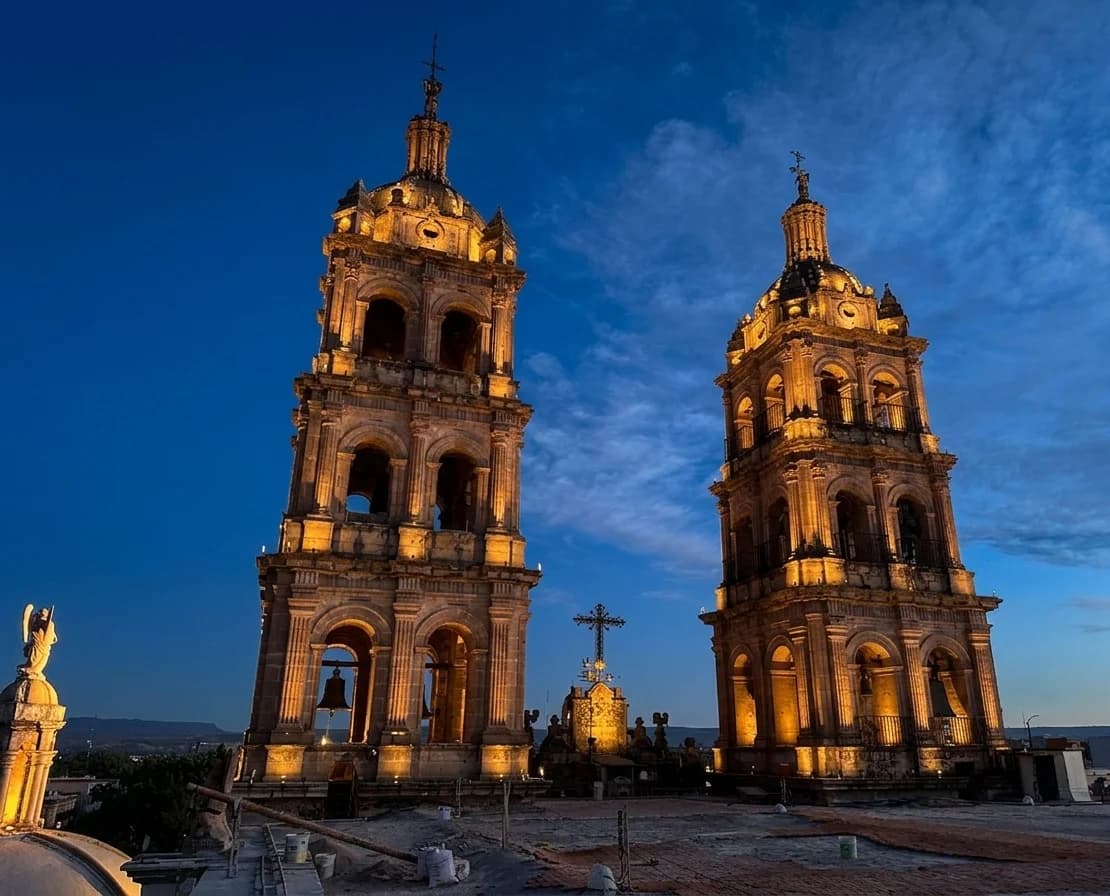
The architectural complex was not limited to the church but included vital annexed spaces such as the treasury house, the chapter hall, and the canons' hall. The exterior was protected by a lime-and-stone enclosure with seven porticoes, separating the sacred space from the urban surroundings. The three-tiered towers, with their 24 bell niches crowned by iron crosses, served not only an acoustic function with their 21 bells and chimes, but also stood as the highest point on the horizon, symbolizing the visual and spiritual dominion of the Church over New Vizcaya.
Curatorial text: Museum of the Cathedral Basilica of Durango · Archdiocese of Durango
Historical research: Historian José Alonso Martínez Barrios
Key Elements
Octagonal Drum Dome
Replaced the old crossing tower. Provides a zenithal light axis over the transept and improves the exterior aesthetics.
Baroque Portals
A coexistence of styles: classicist base, Solomonic columns on the upper tiers.
Three-Tiered Towers
24 bell niches, 21 bells, and iron crosses. The highest point on the horizon of New Vizcaya.
Lime-and-Stone Enclosure
A forecourt with seven porticoes separating the sacred space from the surrounding urban environment.
Gallery Architectural
Main façade
View of the Cathedral
Architectural detail
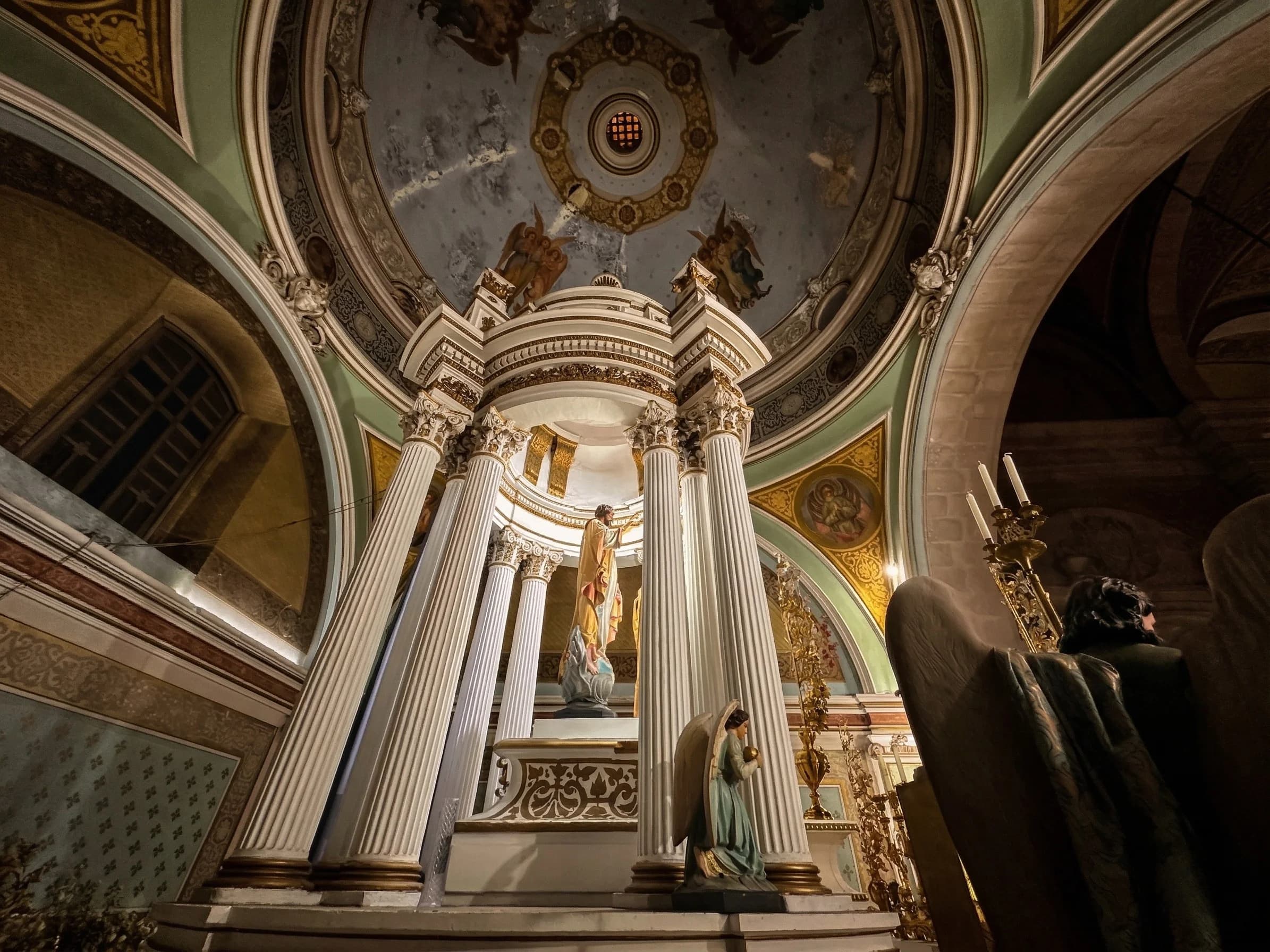
Interior of the Blessed Sacrament
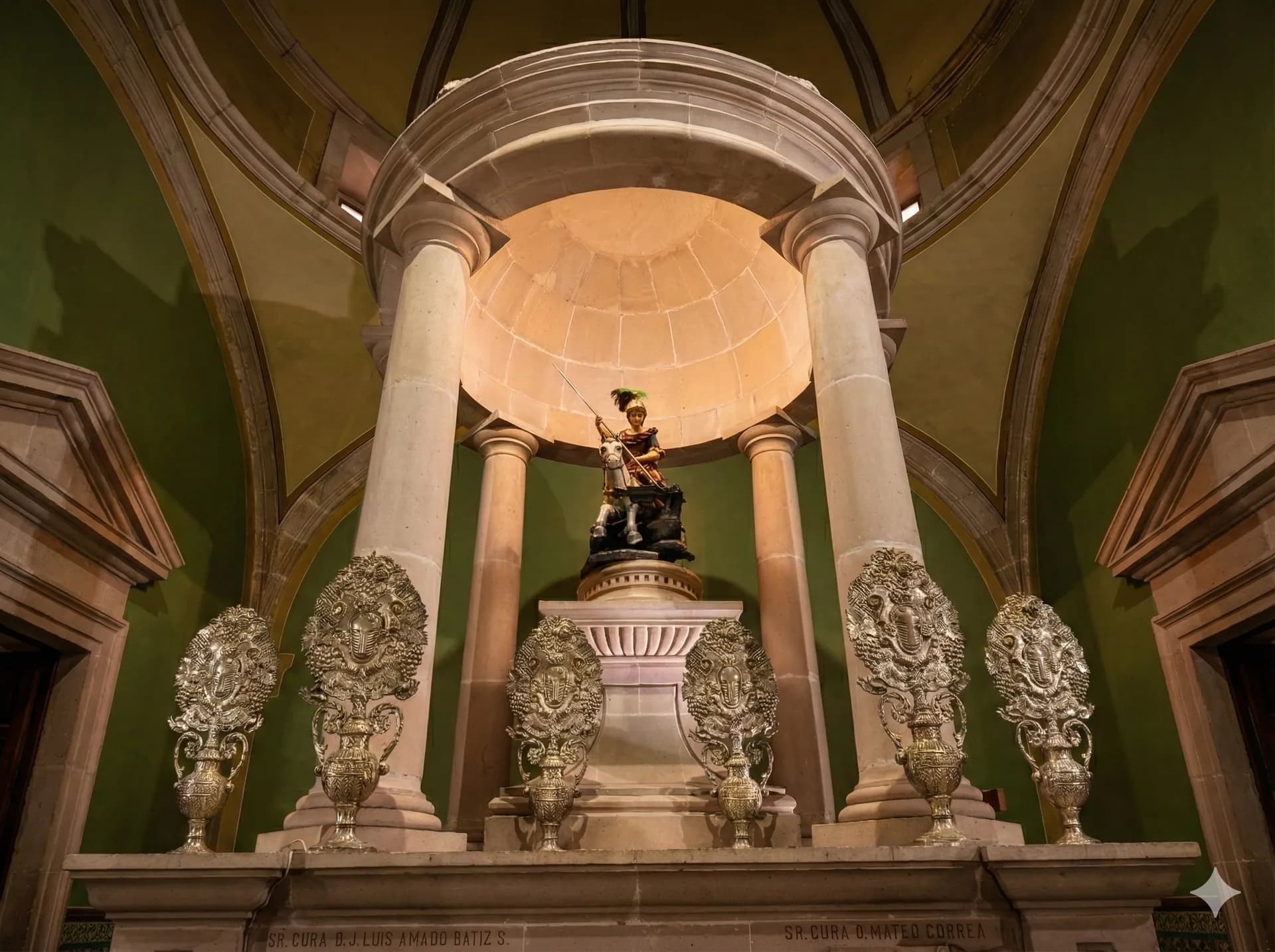
Sculptural detail
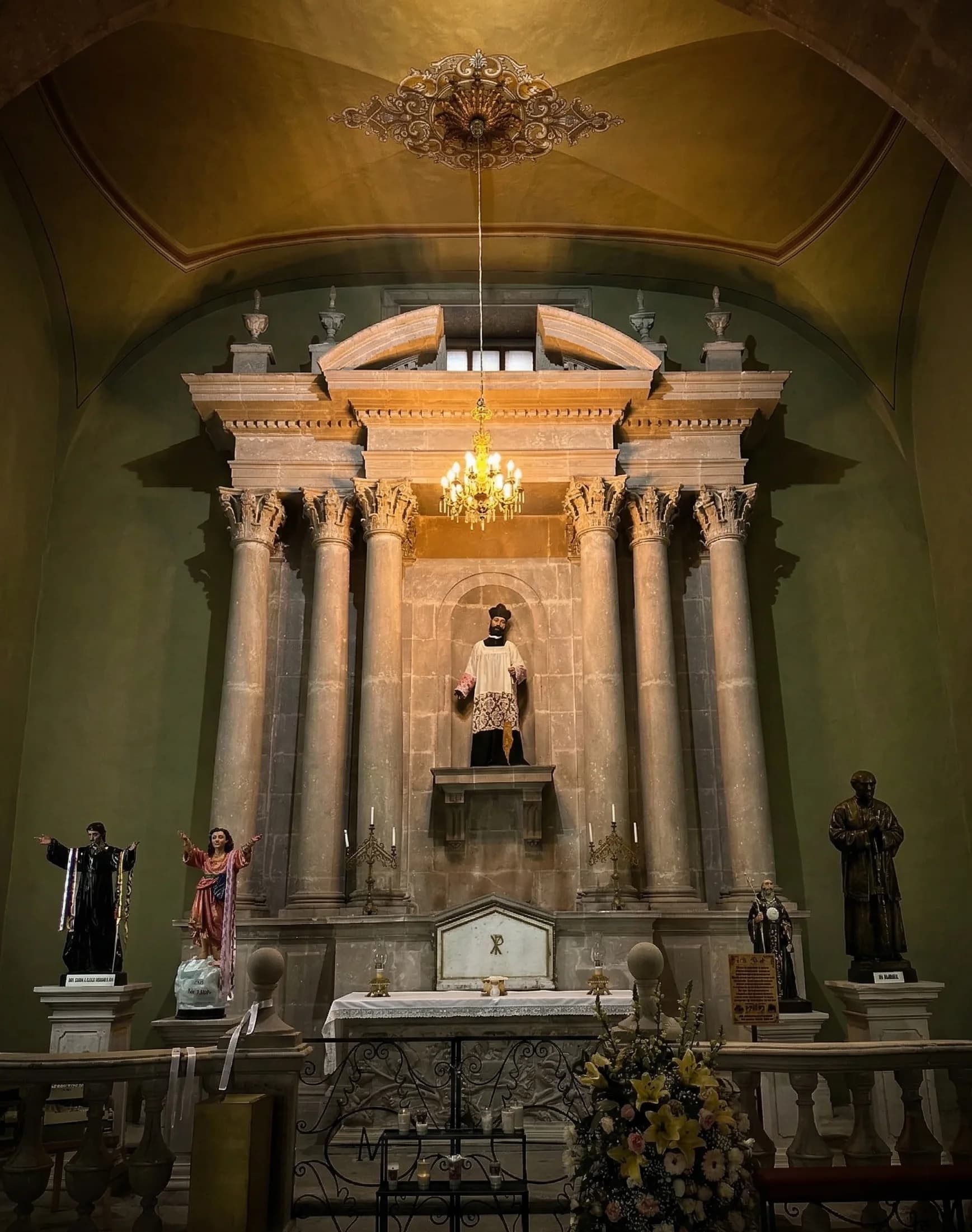
Chapel of Nepomuk
Detailed analysis
The Three
Portals
Main Portal
Simón de los Santos · José de la CruzThree tiers in stylistic evolution from classicism to Solomonic baroque. The ground level features Corinthian columns with Saints Peter and Paul. The keystone of the central arch shows the Christ Child held by an indigenous child — a unique symbol of New Spanish syncretism. The second tier (1721, José de la Cruz) houses a stone genealogical tree with Saints Joachim, Anne, John the Baptist, and Joseph. The mixed-line crown has displayed, since 1821, the republican eagle in place of the viceregal coat of arms.
View portal →East Portal
Miguel de Ontiveros · Pedro de HuertasConsidered the pinnacle of ornamental baroque in northern Mexico. The ground level has extraordinary Corinthian columns whose shafts are canvases of fluting, banding, and anthropomorphic figures. The lateral aedicules shelter Saints Matthew and Mark with Christ dictating the gospel in the background. The entablature frieze traces the symbols of the Lauretan Litany and the cornice houses God Pantocrator. The second tier (Huertas) incorporates estipite columns and protective figures: Saint Barbara against lightning and Saint Petronilla against drought.
View portal →West Portal
Miguel de OntiverosTwin sister of the east portal in date and author, but with its own iconographic program. Carved by Ontiveros with the 7 angelic Thrones and the symbols of the Lauretan Litany in the frieze. Saint Michael the Archangel occupies the keystone as guardian of the temple. The ensemble reflects the 'grammar of abundance' of late baroque: every free surface is an opportunity for visual narrative.
View portal →Towers and Domes
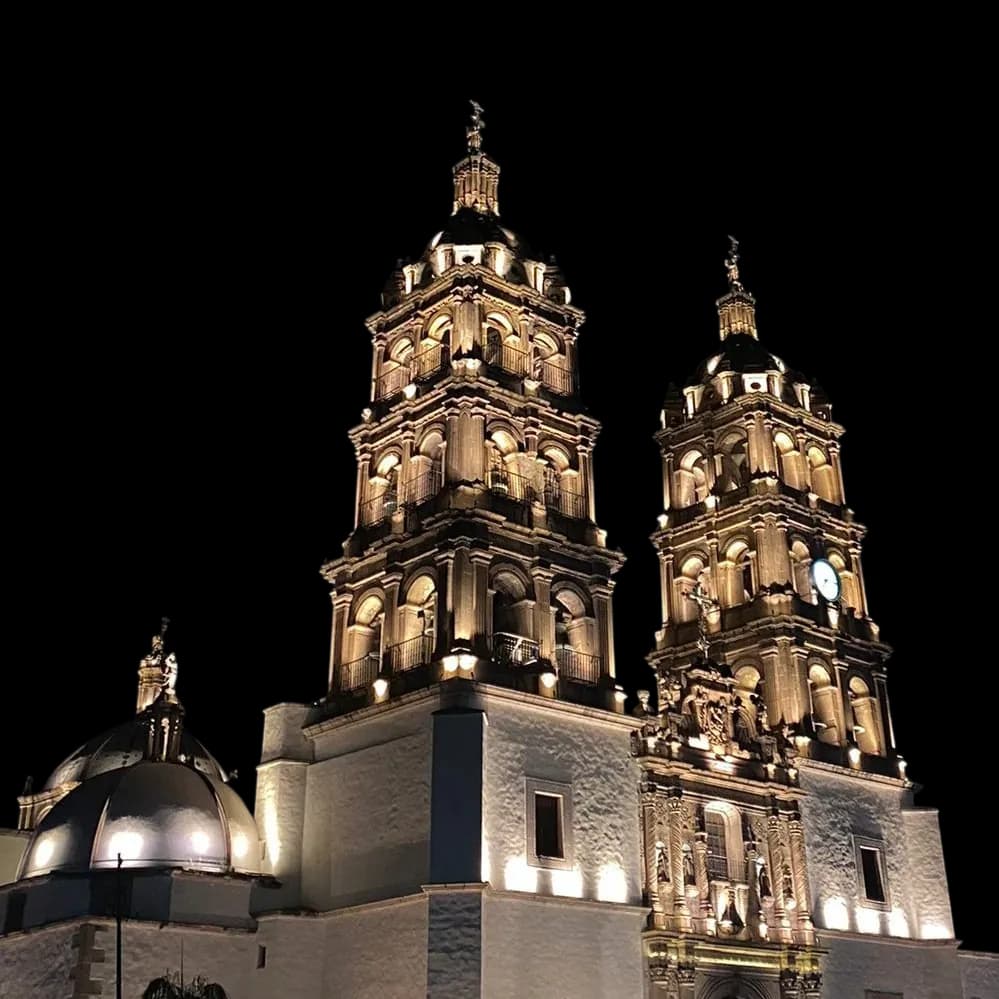
The west tower began in 1699 under Simón de los Santos and was completed in 1721 by José de la Cruz, with twenty-four iron balconies brought from Seville. The east tower, a lengthier process, was finished by Nicolás Morín between 1784 and 1787; it houses a clock added in the 19th century. Together they total 21 bells and chimes, among which the largest, dedicated to the Immaculate Conception, stands out.
The main octagonal dome, the work of Miguel de Ontiveros, incorporated at its vertices sculptures of angels bearing individual letters; viewed together they form the angelic salutation "Ave María". The side domes were crowned in 1897 by Benigno Montoya Muñoz, who added the figures of the Archangels Saint Gabriel and Saint Michael as guardians of the sanctuary.