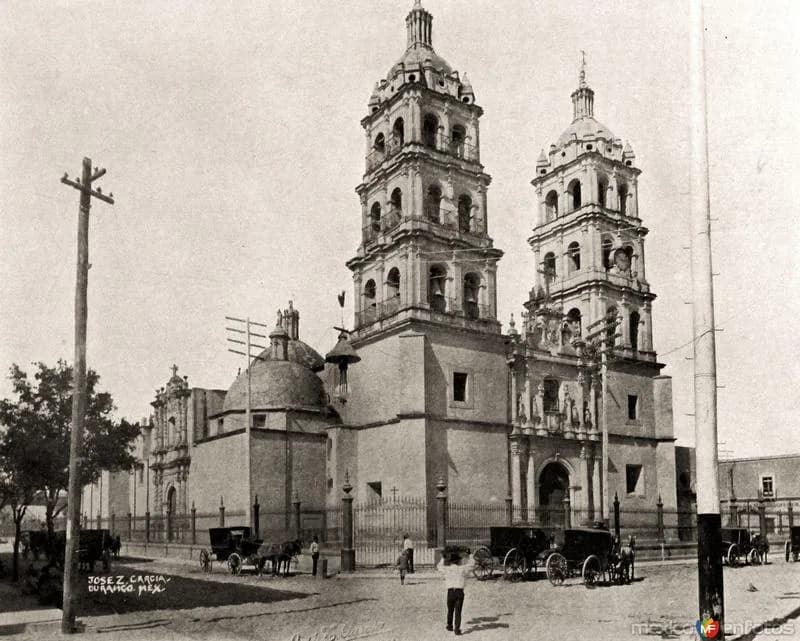
Cathedral of Durango
History
The story of the consolidation of New Vizcaya, from its founding to its rise as the supreme symbol of faith in northern Mexico.
Foundation and
Construction
The history of the Cathedral of Durango is the story of the consolidation of New Vizcaya. Begun in 1620 with its first Bishop Gonzalo de Hermosillo and the cathedral construction in 1695 under Bishop Felipe García de Legazpi, the project was made possible by the economic recovery of mining and the pacification of the frontier following the indigenous wars. Throughout the 18th century, the work passed through the hands of various master builders who contributed their regional styles: Mateo Núñez and José de la Cruz brought the technique of Guadalajara, while Simón de los Santos contributed the Portuguese tradition and Miguel de Ontiveros the influence of Zacatecas.
Financing the work was an ongoing challenge. In the absence of direct Crown support during certain periods, the bishops and chapter had to rely on the 'reales novenos' of tithes and the capitular table itself to cover expenses. There were moments of crisis, such as the flight of Felipe Ureña in 1752 over financial difficulties and the disputes with master builder Pedro de Huertas that halted construction in the 1760s. Nevertheless, the perseverance of figures such as Bishop Pedro Tamarón y Romeral ensured that the work never came to a definitive halt.
The main construction cycle closed between 1783 and 1788 under the direction of Nicolás Bautista Morín, who completed the towers and the crown of the main portal. The cathedral was not only the religious center but also the engine of civil development in Durango; masters such as Huertas took advantage of their time there to build manor houses for the local mining aristocracy. In the end, the cathedral rose as the supreme symbol of the Hispanic monarchy and the Church in northern Mexico, unifying faith, architecture, and social order in a territory that, until shortly before, had been a land of war and uncertainty.
Curatorial text: Museum of the Cathedral Basilica of Durango · Archdiocese of Durango
Historical research: Historian José Alonso Martínez Barrios
Chronology
1620
First Bishop of Durango, Gonzalo de Hermosillo
1695
Start of cathedral construction under Bishop Felipe García de Legazpi
1752
Financial crisis and flight of master builder Felipe Ureña
1760s
Temporary halt of construction due to disputes with Pedro de Huertas
1783–1788
Closing of the main construction cycle under Nicolás Bautista Morín
Gallery Historical
Cathedral of Durango — Historic view · Source: mexicoenfotos.com
Before the
Cathedral
The cathedral's origins date to 1570, with the modest parish of San Mateo erected by Antonio de Espinoza. The building's destiny, however, was marked by adversity: after being elevated to cathedral status in 1620, an accidental fire on the eve of Corpus Christi in 1634 and a devastating lightning strike in 1682 forced the builders to rethink the structure from its foundations.
It was in 1692 that Mateo Núñez and Simón de los Santos began the formal reconstruction, defining the interior spatial character we admire today: they raised the pillars and formed the ribbed vaults that give the sanctuary its imposing character. The cathedral we know is, in essence, the third version of the same building, enriched by each generation of builders.
The cathedral's history did not end with independence. In 1821, as national sovereignty was achieved, the Spanish royal coat of arms on the main portal was replaced by the Mexican republican eagle, transforming the building from a symbol of viceregal dominion to an emblem of the nation. This gesture was not merely political: the cathedral was assuming its role as a faithful mirror of the history of Durango and the country.
Before 1620
1570
Foundation of the parish of San Mateo by Antonio de Espinoza
1620
Elevation to Cathedral status. First bishop: Gonzalo de Hermosillo
1634
Accidental fire on the eve of Corpus Christi
1682
Devastating lightning strike that forced rebuilding from the foundations
1692
Formal reconstruction under Mateo Núñez and Simón de los Santos
1821
The republican eagle replaces the viceregal coat of arms on the main portal