 Imagen: descubro.mx
Beatriz,
the Moon Nun
Narrated by Professor Manuel Lozoya Cigarroa
It is told that there once lived in the city of Durango a family whose name has been lost to time, originally from Topia, a mining town nestled in the heart of the Sierra de Durango. The father had devoted himself to mining; the mother was the very picture of the homemaking woman. Life had gone by, with special attention given to Beatriz, the couple's only daughter.
Beatriz was a beautiful young girl with fair skin, lightly tanned by the mountain sun, long blonde hair, blue eyes, a small mouth with thin red lips, sturdy and of tall, well-proportioned stature. As she was the only daughter and her parents had the means to do so, they thought of giving her a good education. Moved by this resolve, the family relocated to the city of Durango, settling in a house on Calle del Pendiente, very close to the cathedral where Beatriz would be forever immortalized in the legend of the Moon Nun of the Cathedral of Durango.
It was in the 1850s when the young woman decided to enter a convent of nuns. Her parents, who loved her so dearly, immediately approved of the idea, considering that they would rather see her wed to Christ than to any mortal man. Beatriz went off to the convent; her father, besides paying a large sum of money for the corresponding dowry, donated his fortune to the monastery where his daughter had entered.
Those were the turbulent years of the struggles between liberals and conservatives. Juárez, in a desperate effort to free his people from oppression, promulgated the Reform Laws and the Constitution was reformed. The clergy, feeling their interests threatened, closed some convents and religious institutions, among them the convent where Beatriz was staying. The nun returned home, only to find the unpleasant surprise that her mother had died and her father was gravely ill.
When Beatriz left the convent, neither the dowry nor the fortune her father had donated upon her entry were returned to her. The family's financial reserves had been exhausted. The old man died, and she had to mortgage the house to bury him, putting her only remaining property at risk. Beatriz was left wrapped in terrible solitude, protected by her faith and sustained by the hope of soon returning to her monastic life. Her entire routine consisted of going out in the morning to Mass and in the afternoon to the rosary at the nearest church, which was the cathedral.
While this woman's life slipped by in a lazy routine, the French Imperial troops, commanded by General L'Heriller, entered Durango without resistance. The men, mostly young men of the city, never took kindly to what they saw. They hated the French for being invaders, and if the city had put up no resistance, it was not for lack of courage but for lack of resources to organize a defense. This hatred gave Mexicans reason to kill a Frenchman whenever the opportunity arose.
Thus it happened that on a dark and rainy night in the month of August 1866, a young Mexican man who was trying to meet with his sweetheart and a young French officer named Fernando who was attempting to court the same lady found themselves on the same street. There was no exchange of words between them; the man from Durango, dagger in hand, lunged at the intruder and struck him two or three times. Fernando, feeling himself wounded, fled. Aware that if his rival caught him he would not be left alive, he knocked on the first door he found: it was Beatriz's house.
The young woman, hearing the strong and desperate knocking, sensed that her help was a matter of life and death. She opened the door; the badly wounded Frenchman entered and collapsed, bleeding and unconscious, on the floor of the entryway. The nun shut the door, threw the latch violently, and stood there dumbfounded. At last the fright passed, and she cleaned the blood from the wounded man's head and applied cold-water cloths that brought him back to consciousness. When the soldier had taken a few sips of fresh water, Beatriz opened the entryway door and asked him to leave the house at once.
Fernando begged her to let him spend that night there to save his life. Faced with the choice between life and death, he shut the door abruptly and, drawing a short sword, pressed it against her chest, saying: "If you make a scene, I will kill you." The nun chose to stay silent and await the outcome of things. After a good while of silence between the two of them, he told her everything and pleaded for her help, handing her a good fistful of gold coins. In the end, Fernando remained hidden in Beatriz's house.
She healed him and cared for him with great devotion. The two were young, more or less the same age, and good-looking. They fell deeply in love with one another; feeling that she had found the man of her life, Beatriz gave herself to him body and soul. The two lived moments of sublime happiness, the kind that are rare in the lives of human beings but which, when they arise, must be lived to the fullest.
Things changed. Napoleon ordered the withdrawal of French forces from Mexican soil; the French army, without Fernando's knowledge, abandoned the city of Durango. Upon learning of this, the soldier of our tale sensed that his days were numbered; sooner or later he would be discovered and end up before a firing squad. It was urgent that he leave Durango. The nun got him a saddled horse, lent him provisions, and on a night in November 1866 the French officer slipped stealthily out of the city. Beatriz walked with him to the edge of town where the Analco neighborhood ended, on the road to the Port of Mazatlán.
The farewell was painful, as all farewells are between two people who love each other. The couple's tears dampened that November night; they held each other tightly in a desperate embrace and shared a long kiss. She removed a gold medal she wore on her chest and, hanging it around his neck, said: "So that it may watch over you." Fernando mounted his steed and vanished into the distance and silence of the night.
Fernando did not know the road that would lead him to the Port of Mazatlán. As he rode away from his beloved and felt himself alone before that splendid nocturnal panorama, he gazed at the stars and wept torrents of tears. He felt himself the most wretched man on earth: without a homeland, without family, without money, without knowledge of the terrain, without companions, and bearing the terrible stigma of wearing the uniform of an invading army in retreat.
He felt that his life was now counted in hours, and he bitterly regretted not having stayed with Beatriz. The power of love had triumphed: he turned his horse's reins to set off on the road back, at the very moment when the vanguard of a Juarista guerrilla band, quartered at the old Hacienda de Tapias, called out to him, "Who goes there?" Fernando dug his spurs into the horse and shot off like a bolt of lightning. He did not get far: a volley of rifle fire broke the silence of that early morning, and Fernando's body rolled lifeless to the ground.
After examining him and searching his pockets, they found no identification whatsoever. In a leather satchel there was only a gourd of water, some gorditas filled with spiced mashed beans, and a few flour rolls wrapped in a hand-embroidered napkin. That soldier carried nothing of importance. Only a small gold medal hung from his chest, bearing the image of the Immaculate Conception, with a name engraved on the back that read: Beatriz.
Beatriz knew nothing of this. Perhaps, had she known, she would have died of anguish. She lived because she belonged to Fernando and kept herself for him; she believed her beloved's return was a matter of days, or at most months. In her home she returned to a life of solitude and routine: Mass in the morning, the rosary in the afternoon, and embroidering and weaving to make the sacred cloths of the church.
She was tormented by the knowledge that she was now a mother, that within her womb beat a life born of her love with Fernando; that the mortgage on the house was about to come due and she had no money; that if the convent reopened she would not be able to return. These and many other reflections weighed on Beatriz every day and every night. At last, exhausted by weeping and worry, she would finally fall asleep.
So one month passed, and so three months passed without news of her beloved. She took comfort in the thought that he did not write because his return was near. So great was her faith that the idea of Fernando's return became an obsession, and every night of the full moon, when Beatriz went to the evening rosary, she would hide behind a confessional in the cathedral so that, once the doors were closed, she could climb the spiral staircase to the bell tower. For the height of the tower allowed her to command a greater view of the horizon, to gaze upon the vastness toward the west, from where her beloved had to appear.
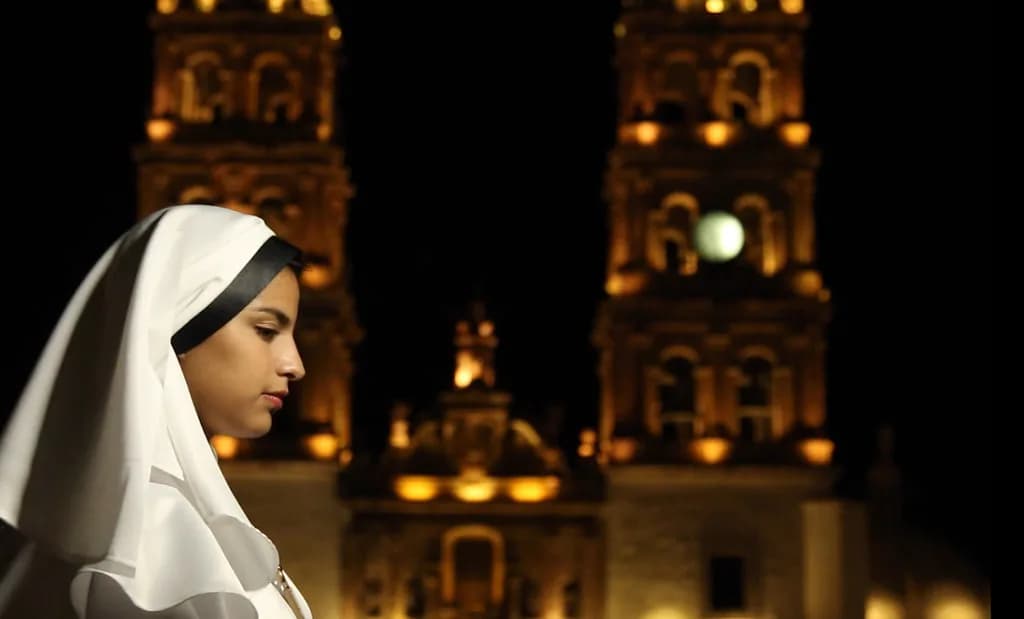
Every day, every afternoon, and every night, Beatriz climbed to the top of the cathedral's left tower to search the horizon, awaiting Fernando's return. At last, when Beatriz's child was about to be born, one morning in the month of April, at the first light of dawn, as the sacristan of the temple opened the main door of the church, he saw lying on the cathedral's tiled atrium the body of a woman who, with her arms spread across the ground, lay dead, her form stamped into the pavement after plummeting from the top of the tower. It was never known whether it was suicide out of despair and heartbreak, or an accident brought on by exhaustion and sleeplessness. The reality: Beatriz died from a fall of more than thirty meters, when her child was only days from being born. And ever since, on every night of the full moon, the silhouette of a nun dressed in white can be seen in the bell tower of the left tower of the Cathedral of Durango, kneeling, gazing westward, imploring for the return of her beloved.
Legend collected from the oral tradition of Durango.
Narrated by Professor Manuel Lozoya Cigarroa.