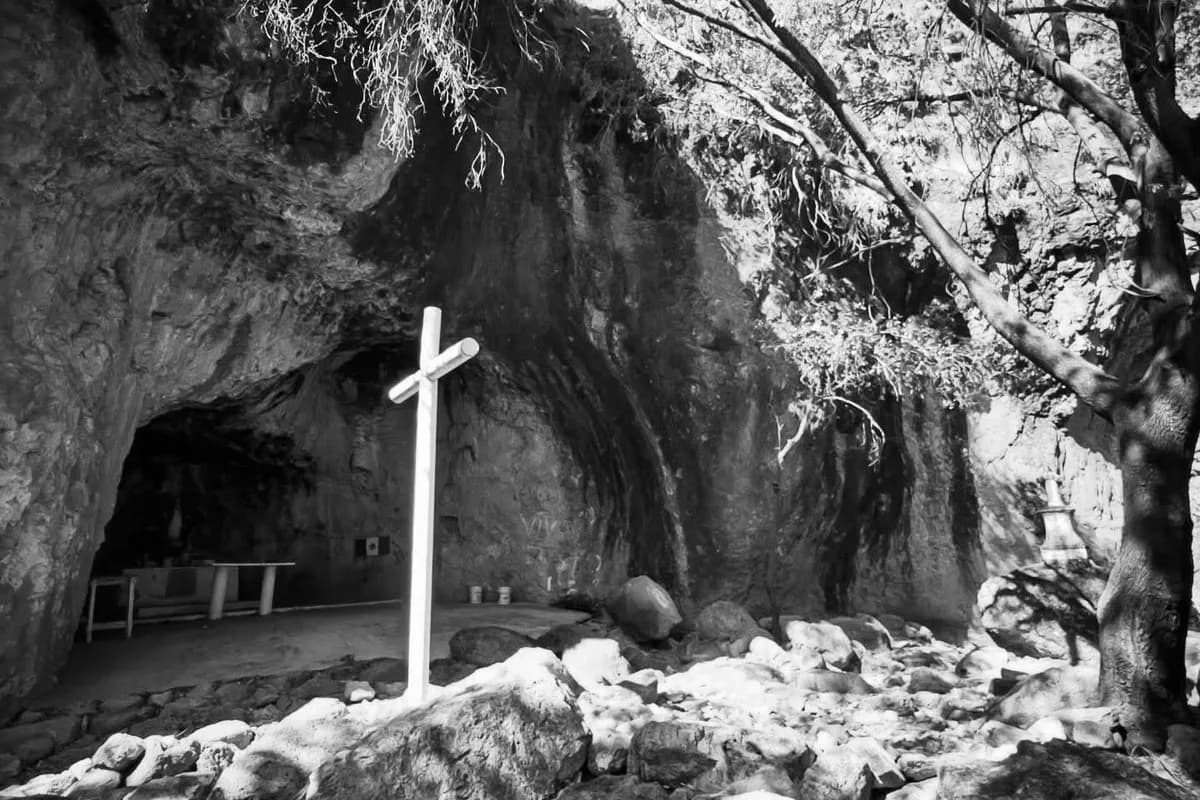
 Imagen: Viva Durango / Facebook
The Cave
of the Bishop
Narrated by Professor Manuel Lozoya Cigarroa
In the foothills of the Sierra Madre Occidental that some geographers call the Sierra de Cacaria, precisely at the Arroyo de las Moras, in the municipality of Canatlán, there is a small cave that the locals call the Bishop's Cave, for having been the refuge for more than two years of His Excellency Bishop Don José Antonio López de Zubiría y Escalante, shepherd and pastor of the Diocese of Durango from 1831 to 1863.
According to stories, traditions, and tales, the ecclesiastical government of Don José Antonio was one of the longest and, at the same time, most disputed, owing to the political situation he lived through. His biographers agree that he was a man of great character and strong personality, qualities that contrasted with his meekness, kindness, charitable spirit, and readiness to serve all who needed his services.
It is said that on one occasion, around nine at night, a person arrived at the bishopric requesting his Lordship's services to go and hear the confession of a dying man. The person who received the request excused the bishop, explaining that he was very tired and already resting, and recommending that the service be requested from any other parish. After a good while, there was a knock at the door of the bishopric, and the doorkeeper was astonished to see his Lordship enter, having gone to provide the confession that had been requested. No one had given him the message, nor had anyone seen him leave, yet he had fulfilled his duty by hearing that confession.
On another occasion, a pair of criminals planned to kidnap the Bishop to demand a large sum of money and thus resolve the pressing financial situation that afflicted them. The plan was for one to pretend to be gravely ill and, when the Bishop approached his bedside, to threaten him with a dagger; the other would prevent the prelate's escape by guarding the door of the room. It had been arranged that the Bishop would not, under any circumstances, come out of the ordeal alive.
At dusk, an elegant carriage arrived at the door of the bishopric, requesting the Bishop for an urgent confession. The coachman stated that the dying man needed to make an important revelation to his Lordship, and that he needed to attend in person, unaccompanied by anyone. His Excellency boarded the carriage and prepared to carry out his ministry.
The night was dark, the city lay in shadow, and the howling of dogs and the calls of owls set the terrifying scene for a fatal event. After much traveling through streets and alleys, the carriage stopped at a house of ill repute. The prelate did not hesitate; with a firm step and apostolic bearing he entered the entryway, and guided by the dying flame of a candle, they reached the sick man's room. Upon looking at him, the bishop said to his companion: "We have arrived too late, the sick man has already passed."
Upon lifting the sheet covering him, they noticed that the dead man held in his right hand a sharp dagger, ready to plunge it into the visiting Bishop's chest. The elegant coachman, terrified by what had occurred, confessed the whole elaborate plan to the illustrious visitor. Upon hearing the confession, Don José Antonio reproached the confessor for nothing. He took a handful of gold coins from his pocket, gave them to the poor man, blessed him, and ordered him to shroud the deceased. The Bishop faded away at a slow pace into the darkness of the night, and spoke to no one of what had happened.
It fell to this illustrious figure to face the tempestuous era of the Reform Laws. The Bishop of the Diocese of Durango did not recognize the Political Constitution of Mexico enacted on February 5, 1857, a stance that brought upon him a terrible persecution that forced him to withdraw from his bishopric and hide at the Hacienda de Cacaria. The Government soon discovered the place where his Lordship was hiding; however, that same afternoon his Excellency appeared at the Hacienda de Cacaria, without the padlock of the storeroom ever having been opened.
The illustrious figure, Don José Antonio López de Zubiría y Escalante, died at the Hacienda de Cacaria on November 26, 1863. His remains were transferred to the crypts of the Cathedral of Durango on December 1, 1864. The Bishop's Cave, hidden in the Arroyo de las Moras of the Sierra de Cacaria, still preserves the altar and the wooden cross where the Bishop celebrated Mass more than a century ago. The locals keep the tradition of having a Mass celebrated there every year, on October 25, a date on which the place draws large crowds. Oral tradition holds that somewhere in the small cave lie buried a chalice, a monstrance, and a crucifix, all of pure gold set with precious stones, ornaments of the Cathedral of Durango that the Bishop carried with him into exile.
Legend collected from the oral tradition of Durango.
Narrated by Professor Manuel Lozoya Cigarroa.